go back
From Subcontractor Dependency to Full CFM56 Coverage: What the Balancing Machine Investment Actually Means

There is a step in engine maintenance that never gets skipped. Every rotating module – compressor discs, turbine spools, fan assemblies – has to be balanced after any performance restoration work or life-limited parts replacement.
“The imbalance of rotating parts can significantly decrease the safety of the engine, causing high vibration and influencing all hardware,” explains Dusan Ristanovic, Deputy Powerplant Engineering Manager at Magnetic Engines. “With the engine’s two rotating systems spinning at roughly 5,000 and 14,000 revolutions per minute, respectively, even a small amount of imbalance can affect overall system stability.”
For Magnetic Engines, that step used to mean sending work out. External partners, added lead time, and in some cases a workscope complex enough that taking it on at all wasn’t practical. The multi-step balancing sequence for the LPT Major Module was the clearest example – the logistics of the subcontracting model made it easier to decline than to deliver.
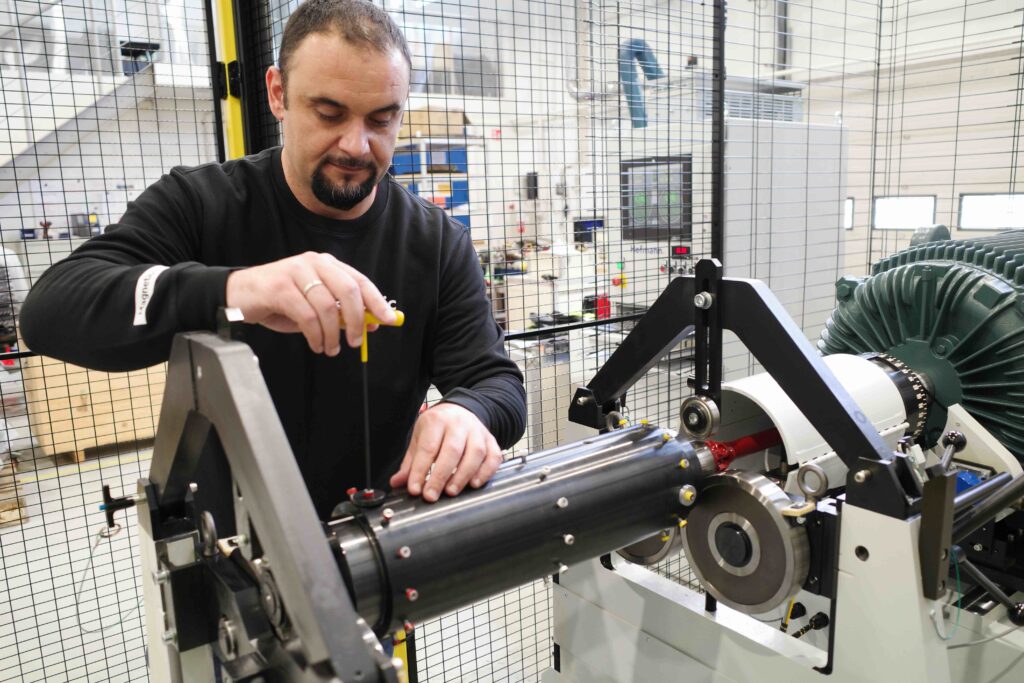
That changes with the acquisition of two specialist balancing machines – one vertical, one horizontal – now operational at Magnetic Engines’ workshop in Tallinn.
“This investment allows us to offer a broader range of repairs while keeping more of the process under our own control,” said Victoria Goodenough, Business Development Manager at Magnetic Engines.
“For customers, that means fewer external interfaces, shorter turnaround times and access to workscopes that were previously unavailable through Magnetic Engines. It is another important step in strengthening our position as a comprehensive CFM56 support provider.”
What’s now possible
The most direct benefit is speed. Workscopes that previously required an external balancing step can now be completed in-house, reducing turnaround times across the board.
But the more significant change is what the machines unlock entirely. Three new product lines are now open:
Full overhaul and rebuild of the LPT Major Module – a workscope that, in revenue terms, sits alongside a full engine repair. This will be available both for external clients and for Magnetic Engines’ own engine assets, making it a meaningful addition to the division’s commercial offering.
Overhaul and rebuild of the Fan and Booster Shop Module (SM21) – previously outside the division’s scope, now a viable and fully in-house service.
Life-limited parts replacement on HPC and HPT rotors – enabling Core Performance Restoration workscopes to be completed with LLP replacement included, rather than requiring a separate external process.
Together, these additions mean Magnetic Engines can now offer full performance restoration across every module of the CFM56-3, -5B, and -7B – end to end, without handing over a critical step to someone else.
Dusan stated, “This will help us reduce TAT for all workscopes where engine modules have to be balanced, plus it gives us the possibility to perform workscopes we couldn’t before.”
“Tooling for disassembly and assembly of modules was already in place,” he continued. “But the repair process itself couldn’t be completed in-house due to the lack of balancing machines. Everything had to be subcontracted, increasing TAT and cost for our clients.”

Why this matters beyond the workshop
The stakes behind this step go further than turnaround time. “Imbalance generates vibrations that accelerate wear on bearings, seals, and other mechanical parts,” Ristanovic explains. “Looking at the wider picture – the whole aircraft – imbalance in the engine can cause significant stress to the pylons and wings.”
Engine capability is not just an operational story. For customers, it means fewer handoffs, shorter timelines, and a single accountable provider across a broader range of workscopes. For Magnetic Engines, it means the ability to take on revenue-generating work that simply wasn’t on the table before.
The LPT Major Module rebuild, in particular, represents a new commercial avenue rather than just an efficiency improvement. Rebuilding modules both for clients and for the division’s own assets creates flexibility that didn’t exist before.
The roadmap continues. As the LEAP programme develops within the division, the intention is to extend balancing capability to cover that engine family as well – building on the same infrastructure now in place for the CFM56.
The balancing machine is not a headline piece of kit. It is not the part of the engine people tend to photograph. But what it enables – and what its absence was quietly preventing – is exactly the kind of foundational capability that determines how far a maintenance operation can actually grow.