go back
Building Aviation Talent, Not Just Hiring It: Why the Industry Must Rethink Workforce Strategy

Ene Krinpus has spent her career thinking about people – where they come from, what they need to grow, and why so many organisations get this wrong. As Managing Director at Magnetic Training and Magnetic Engineering, and the driving force behind Magnetic Academy, she has spent the last several years turning that thinking into something concrete. We sat down with her to talk workforce strategy, the myth of the ready-made professional, and what Zero2Hero has taught her about the future of aviation talent.
There is a version of this conversation that starts with statistics. Projected shortfalls, ageing workforces, licensing bottlenecks. Ene Krinpus knows those numbers.
But she would rather start somewhere else.
“For a long time, aviation recruitment operated in a relatively stable way,” she says.
“People entered the industry in their early twenties and quite often retired from it decades later. The technical trades were popular. Working hands-on on an aircraft was seen as a prestigious career. There were plenty of young people who wanted to become aircraft engineers.”
“Now, it is different.”
The Queue for a Shrinking Pool
The shift Ene describes is not a blip. Demand for qualified aviation maintenance professionals has outpaced supply, and the gap is widening. The talent pool is ageing. Fewer young people are choosing technical careers, and those who do have options their predecessors never had – technology, engineering, and advanced manufacturing – all competing for the same minds with fewer barriers to entry and often faster progression.
“If we continue to depend only on ready-made professionals,” Ene says, “we are essentially competing for a shrinking pool instead of expanding it.”
What makes this particularly acute in aviation is the barrier structure. Licensing requirements, regulatory frameworks, the sheer time investment to reach full qualification – these exist for good reasons and are not going away. But combined with a hiring culture that has historically favoured only the already-qualified, they have created something close to a closed loop.
The industry demands experience that it has not invested in creating.
Current projections put the shortfall of licensed maintenance engineers across Europe at ~12000 by 2035. In some MRO operations, upwards of 35% of the technical workforce will reach retirement age within the next 10-15 years.
“It is a structural shift,” Ene says. “It will not be solved by hiring harder from the same pool.”

The Gap Nobody Was Filling
When Magnetic Academy began looking seriously at this problem, what became clear was not just the scale of the shortage – it was the absence of practical pathways to address it.
“Traditional education routes were either too slow, too theoretical, or not aligned closely enough with real operational needs,” Ene explains.
“There was no direct, structured path for someone with little or no aviation background to enter the industry and become a qualified professional.”
But there was something else, too – a group the industry was quietly losing altogether. Career changers. People in their thirties and forties with transferable skills, genuine motivation, and years of professional experience, who wanted to move into aviation but found no realistic route.
Going back into full-time education was not feasible for most of them. So they went elsewhere.
“The industry was losing this group entirely,” Ene says. “Not because they lacked potential – because no structured route existed for them.”
That observation became the foundation for Zero2Hero: a programme designed to take candidates with little or no aviation background and bring them through to qualified professional status via a pathway built around real work environments from the very beginning.
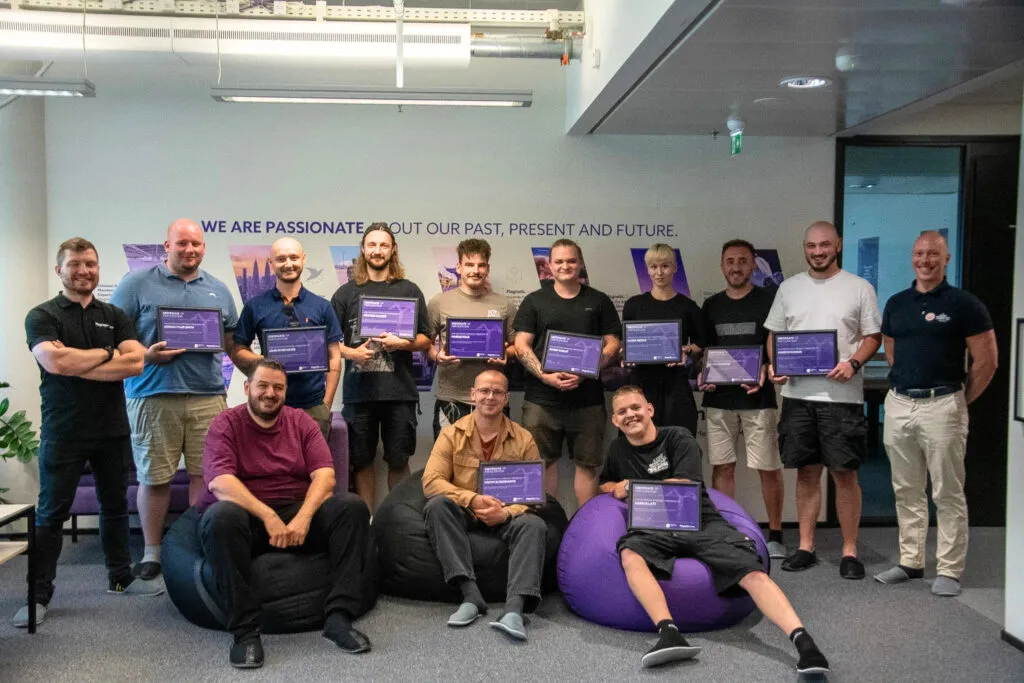
Since its launch, 45 candidates have completed the programme, arriving from backgrounds including maritime and education – one student was even an ex-biology teacher.

What Magnetic Academy Actually Does
Zero2Hero did not emerge from a blank page. It was built within a broader structure – Magnetic Academy – which Ene describes as the backbone of the group’s entire approach to workforce development.
Magnetic Academy runs on two tracks. Zero2Hero serves those entering aviation for the first time. A separate Part-66 Module programme supports experienced employees working towards their EASA licence.
Together, they are designed to cover the full arc – from the first day in the industry to licensed engineer.
“Magnetic Academy ensures that training is not just compliant, but relevant,” Ene says. “It allows us to combine theoretical knowledge, hands-on experience, and mentorship in a way that traditional systems often cannot.”
The numbers reflect that. Magnetic Academy has delivered 4 training programmes with 98% of graduates remaining within the group after 12 months.
“Without that combined structure,” she adds, “we would not be able to develop the workforce sustainably.”
What the Magnetic Academy gives Magnetic Group, she argues, is something that external recruitment simply cannot: control. Over quality. Over pace. Over how closely the training tracks actual operational needs rather than a standardised curriculum designed for the widest possible audience.
Build vs Buy – and Why the Maths Has Changed
Ask Ene whether internal development can genuinely replace external hiring, and she is careful not to overstate the case. “External recruitment has its place. It will always be part of the picture.” But the companies treating it as their primary strategy, she believes, are carrying more risk than they may appreciate.
“Recruitment is reactive,” she says. “It depends on market conditions, competitor activity, the availability of candidates who are already fully formed. When you build talent internally, you are not waiting for the market to supply what you need. You are creating it on your own terms.“
The retention argument is one she returns to more than once. People who come up through structured development programmes understand the culture from the inside.
Their standards, their habits, their sense of what good looks like – all of it shaped within the organisation rather than imported from outside.
“It also creates a stronger sense of ownership,” Ene adds. “Which is very difficult to achieve when talent is sourced purely from outside.”
Perhaps the most striking lesson from Zero2Hero, she says, is the simplest one. “Potential matters more than prior experience – if you have the right structure in place. The limiting factor was never the people. It was the absence of a structured route for them to follow.”

What Needs to Change
Ene does not frame this as a Magnetic story. She frames it as an industry problem with an industry solution – one that requires a genuine shift in how aviation leaders think about their own role in workforce creation.
“Leaders need to shift from a headhunting mindset to a talent-building mindset,” she says. “That means investing in training capabilities, building internal apprenticeship programmes, and forming partnerships with education providers.”
“Companies that take ownership of developing their workforce – rather than relying on the market to supply it – will be the ones that remain strong and competitive in the long term.”
The workforce shortfall in technical aviation is not a temporary dip. It is a long-term structural reality, and the organisations that treat it as such, building infrastructure, committing to timelines measured in years rather than quarters, accepting that talent development is slower and harder than talent acquisition, are the ones that will still have full rosters when others are scrambling.
“Building talent pipelines is not a quick fix,” Ene says.
“But once established, they become a very strong competitive advantage.”
Magnetic Academy and Zero2Hero were built from exactly that belief. The question, as Ene sees it, is not whether the rest of the industry will follow. It is how long they will wait before they do.