go back
The Hangar That Welcomes You to Estonia: Why Magnetic MRO's New Hangar Is More Than Company Branding
When passengers descend toward Tallinn Airport, most expect to see what they’ve seen at every other airport: rows of grey industrial hangars, functional but forgettable.
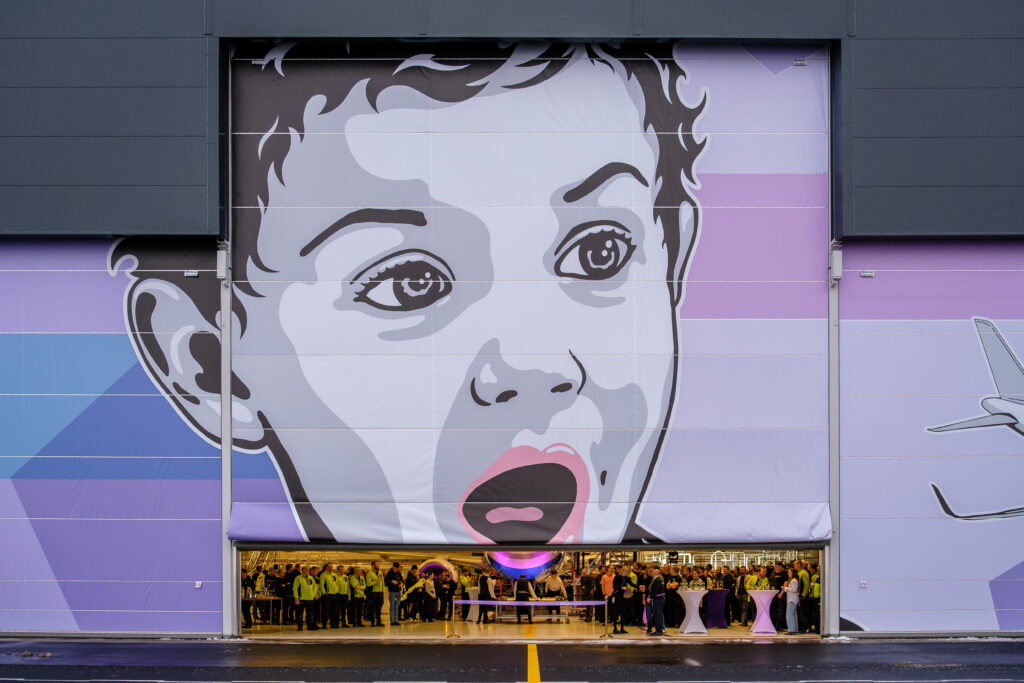
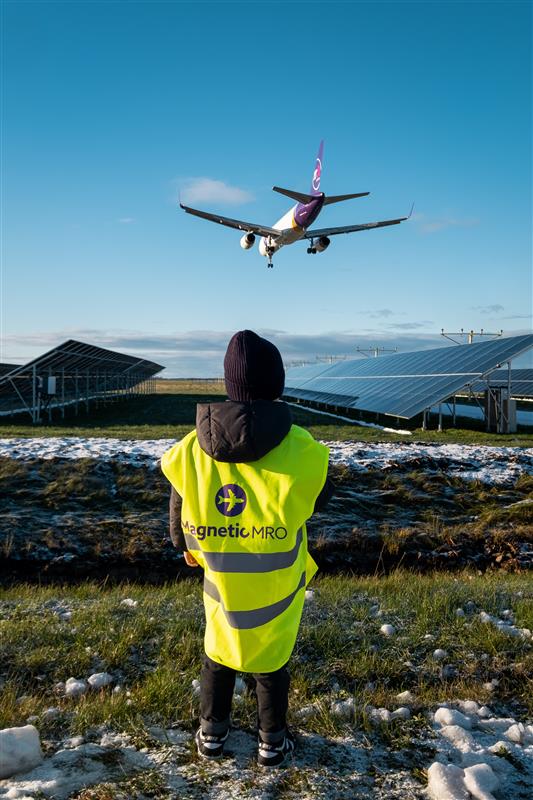
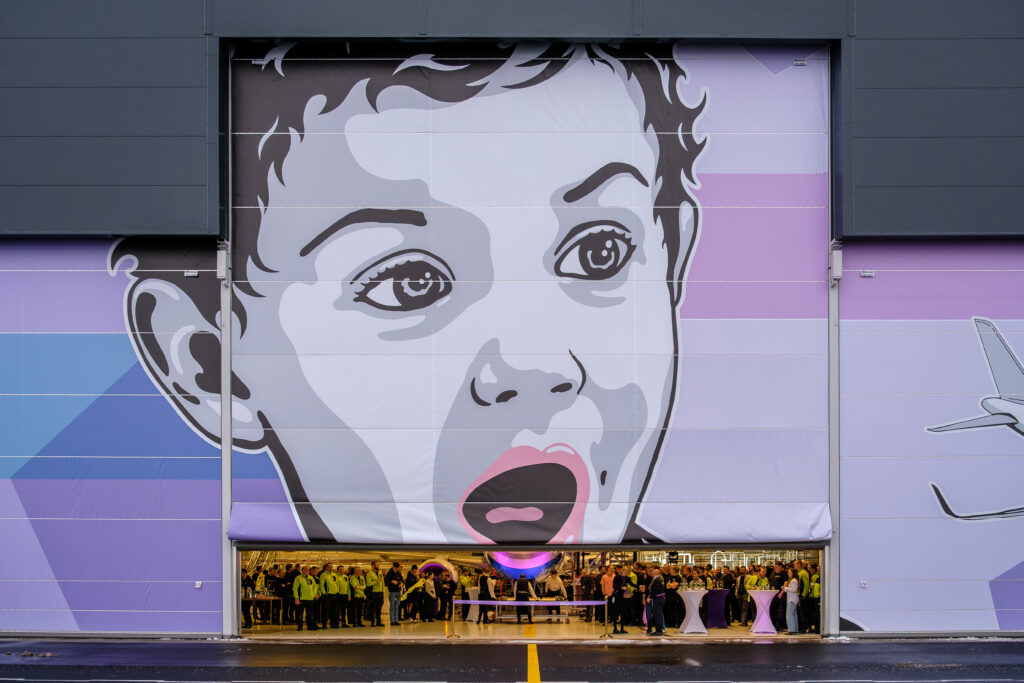
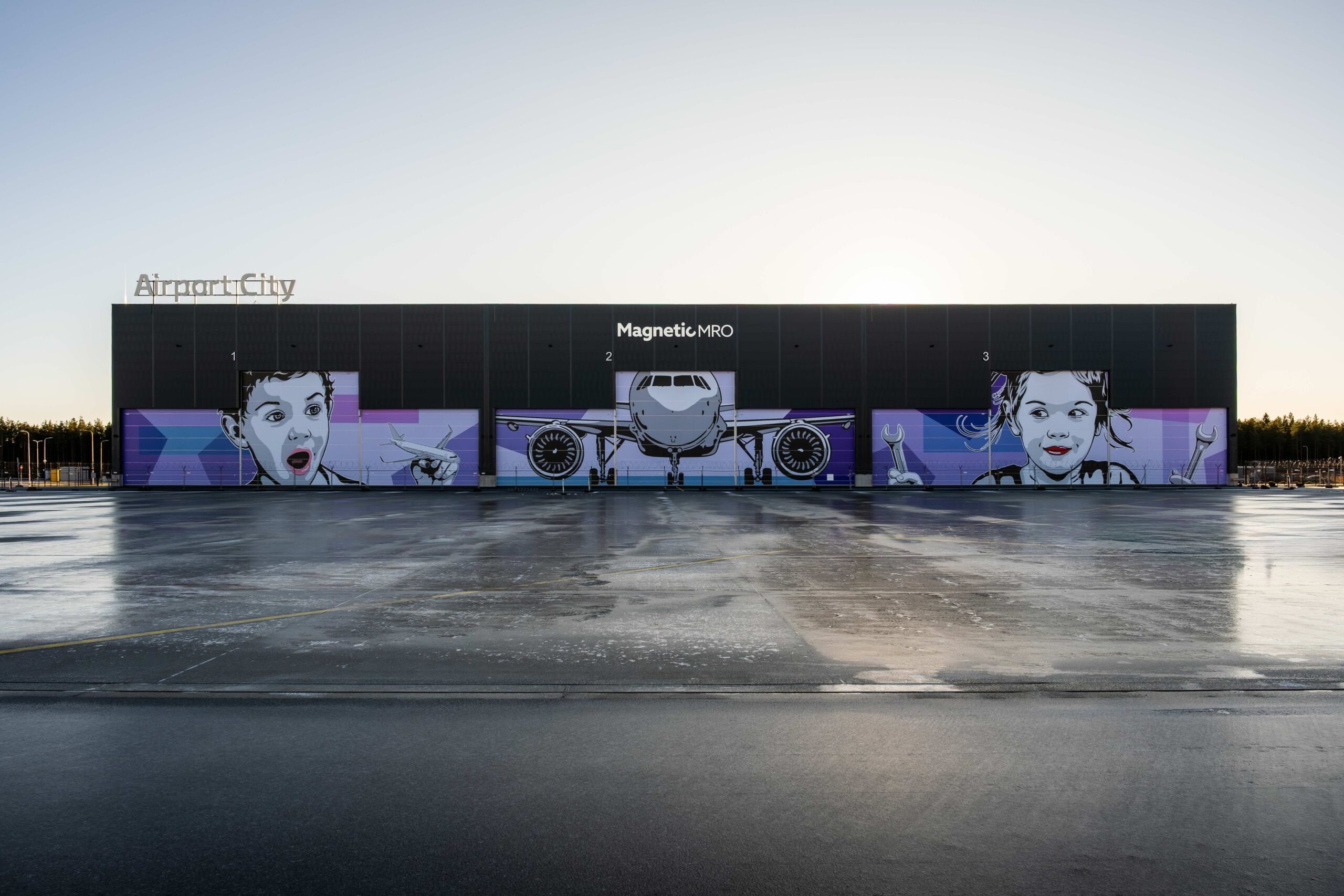
What they actually see is two giant children, a massive airplane painted larger than life, and a visual story that unfolds across three massive doors painted in vivid purples and blues.
“I’m happy that the images I created are among the very first things that greet people arriving in Estonia,” says Von Bomb (Indrek Haas), the renowned Estonian street artist behind the design.
For thousands of weekly arrivals, this hangar isn’t just infrastructure – it’s their introduction to a city and a country.
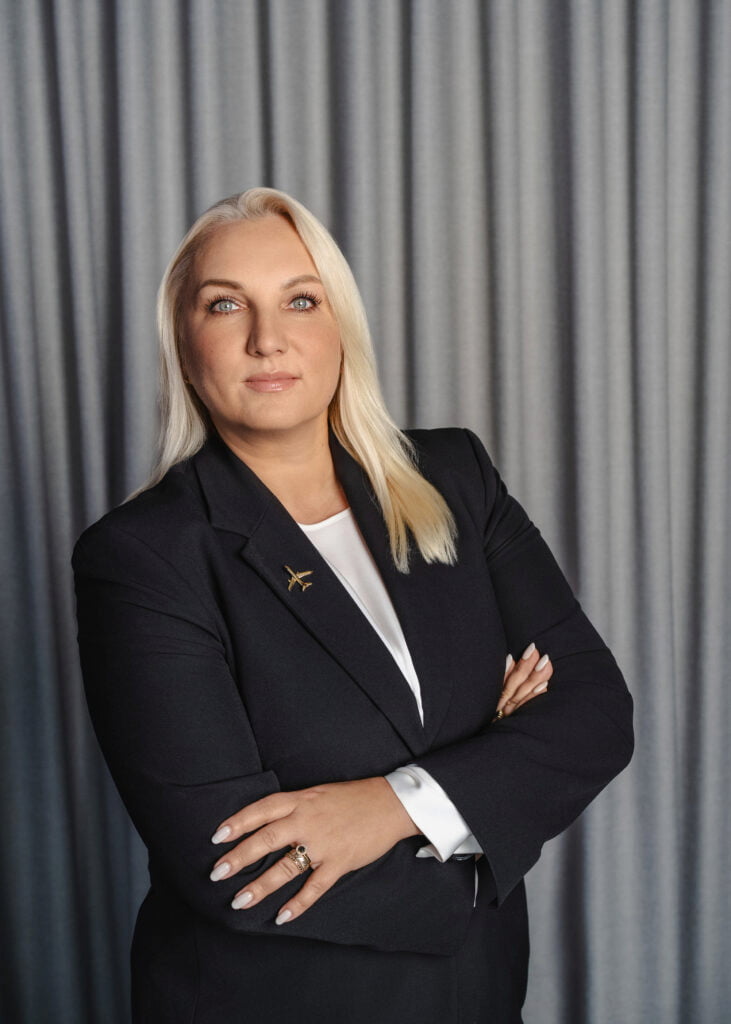
That’s exactly what Tiina Shein, Head of Marketing & Communications at Magnetic Group, intended.
The Collaboration That Started With A Giant Girl
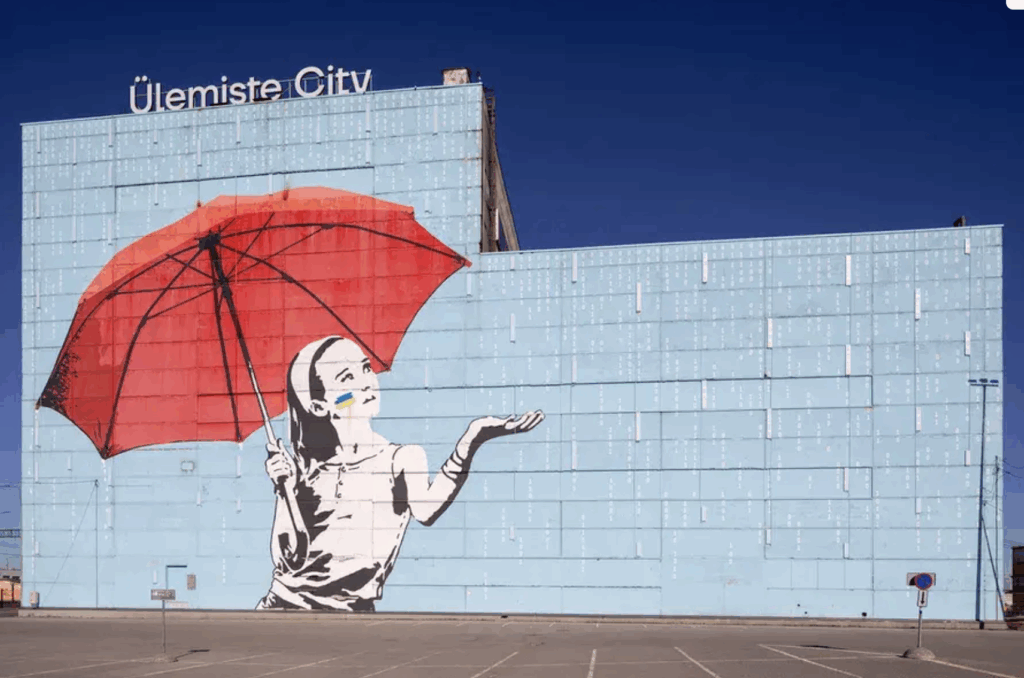
Von Bomb was already well-known in Estonia, particularly for his “Ülemiste girl” mural – a piece that had become part of Tallinn’s visual identity. Magnetic asked him to create something original for their paint hangar. The result was “Girl with the Brush.”
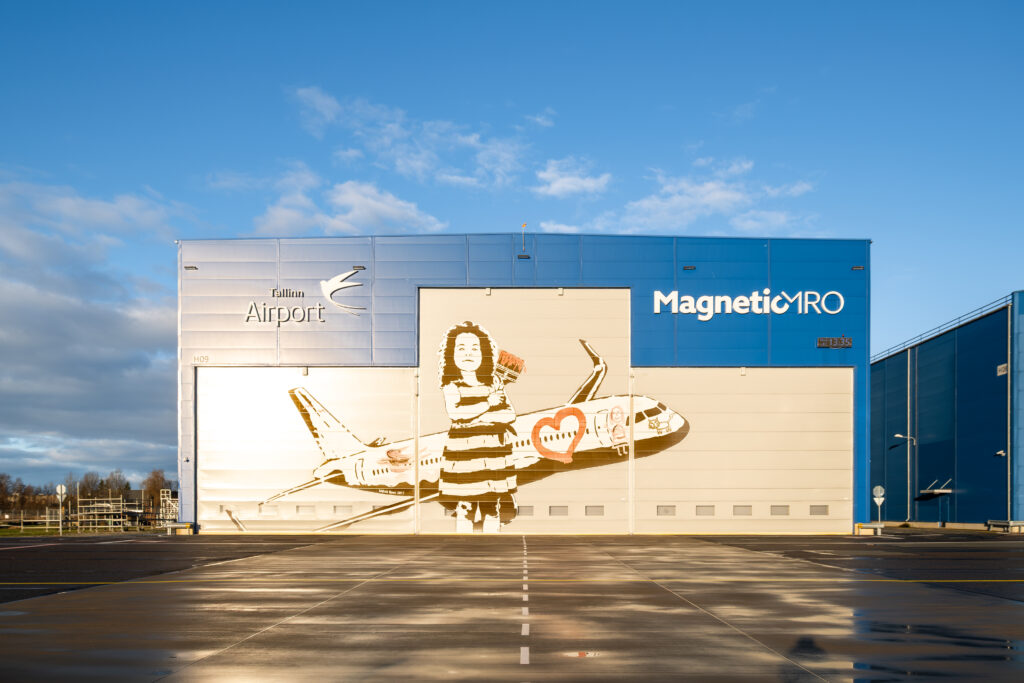
“We had no idea this would become the start of something much bigger,” Tiina recalls. But a few years later, when Magnetic MRO was rebranding into Magnetic Group and searching for a distinctive visual identity, both the CEO and Tiina instinctively knew the answer. “No words were needed,” she says. “That’s how the idea of the Magnetic Kids truly took shape.”
The connection between Von Bomb and Magnetic had a foundation even before that first hangar. In 2015, Von Bomb created a massive mural next to Tallinn Airport in Ülemiste City – “Ülemiste Girl,” spanning 1,780 square meters and still the largest mural in the Baltics.
“That’s probably where the people at Magnetic first noticed my work,” Von Bomb explains. The proximity to aviation, the scale, the boldness – it all aligned.
Three Doors, One Story
For this fifth hangar opening, Von Bomb wanted to do something conceptually richer than simply painting appealing characters. He wanted to play with scale and narrative.
On the first door, there’s a boy with a toy airplane in his hand. Something has gone wrong – his expression captures that universal moment of childhood surprise when things don’t work as planned.
“Before, every maintenance task we did was done outside. It did not matter if it was summer or winter. We even replaced engines outside. There were no hangars at all.”
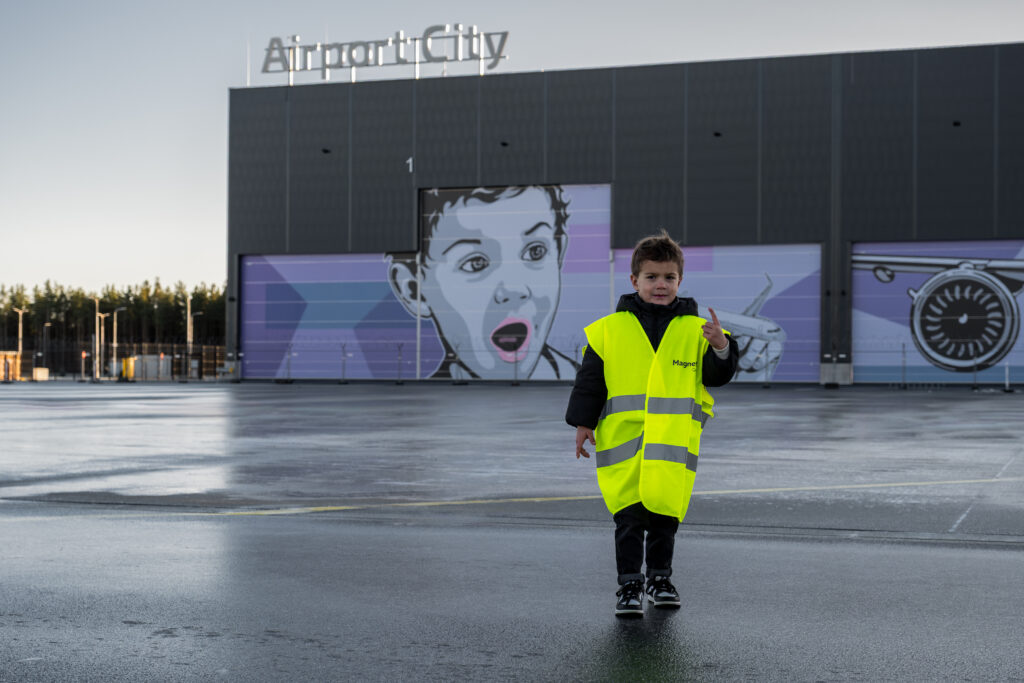
The middle door features an aircraft painted dramatically larger than the real passenger planes that will park in front of it. This isn’t an accident.
“I wanted the figures to be as large as possible while still remaining clear and readable as characters and actions,” Von Bomb explains. “The airplane on the middle door is also made extremely large – noticeably bigger than a real passenger airplane. The purpose was to create a strong wow-effect by contrasting the oversized painted figures with real-life children and aircraft, which are significantly smaller.”
On the third door, a girl holds a wrench, excited and ready to solve the problem. Her expression isn’t one of stress or pressure – it’s enthusiasm. She can’t wait to figure this out.
Problem. Scale. Solution!
“I wanted to play with the sense of scale,” Von Bomb says.
Why Children? Why Now?
The decision to center children in aviation branding isn’t simply aesthetically bold – it’s strategically deliberate.
“Aviation is an industry where serious people do serious business with absolute dedication,” Tiina explains. “There often seems to be no room for fun. But competition is tough, and standing out matters.”
Magnetic Group operates in a global market competing for customers, partnerships, and – crucially – talent. When every aviation company presents itself in dark blue, black, or occasionally red, looking serious and conservative, how do you differentiate?
“At Magnetic, we value curiosity, passion, and vibrancy, while fully respecting professionalism,” Tiina continues. “We believe that adding a touch of childlike enthusiasm, imagination, and even a smile doesn’t weaken professionalism – it strengthens it. It inspires our clients, and just as importantly, our people.”
This is now the third Magnetic hangar where the Magnetic Kids have found a home. But Tiina is careful about how they’re deployed. “We don’t overuse the Kids. I remind myself and my team of this constantly. They are meant to be the cherry on the cake of communication, not the main course.”
The Creative Process: When Trust Meets Ambition
The process of creating artwork for hangar doors at this scale requires both creative freedom and technical precision. Von Bomb’s process began with conceptual ideas – with several options presented for consideration.
Once a direction was chosen, he conducted a photo shoot with child models. “From those photos, I selected a number of images and created the first rough sketches,” he explains. “Together with the team at Magnetic, we chose the strongest ones, and then I moved on to creating the clean final drawings – first with ink pens and later digitally.”
At that stage, technical considerations became critical: the proportions of the doors, structural details, how the images would read from various distances and angles.
“When you have a CEO who truly shares your values, trusts you, and gives you freedom, and an artist who thinks without limits, is ready to experiment, and is excited by a massive canvas – the process becomes surprisingly smooth and fast,” Tiina says. “You’re simply on the same page.”
But she’s also clear that details matter enormously. “Choosing the right kids, the casting, their personalities, multiple photoshoots, their expressions, their eyes, how they pose, what they wear – everything matters.”
Due to technical reasons, the final visuals were not physically painted on the doors – they were instead printed on large fabric panels that can be moved away from the doors if needed.
“I would absolutely love to physically paint something of this scale on a wall in collaboration with Magnetic one day,” Von Bomb adds. “That would be amazing, and I hope the opportunity comes up in the future.”
Creating Breathing Room In An Industry With No Room For Error
Von Bomb’s hope for the artwork goes beyond aesthetics. “I believe that working in aviation can be very intense – there’s no room for mistakes, everything has to be precise and in place,” he reflects.
There’s gentle humor in his work – it’s not meant to be taken too seriously. “At the same time, I hope it inspires a sense of childlike playfulness and curiosity. Innovation plays a huge role in aviation, and the joy of discovery and play can be powerful motivators for finding new solutions.”
This isn’t just artist sentiment – it’s strategic employee culture building.
Magnetic, like many competitors, operates in a labor-constrained market. Creating an environment that people are excited to work in, that reflects energy rather than industrial monotony, is infrastructure – the kind you need when people are your constraint.
Permission To Think Differently
For Tiina, this kind of visual storytelling does something even more important than brand differentiation. “It challenges long-standing industry norms,” she says. “It shows that aviation can remain highly professional while also being bold, human, and emotionally engaging.”
The goal is to invite people to look twice, to remember, and to understand that behind complex engineering and technical excellence, there are curious, passionate people who care deeply about what they do.
“By daring to be different visually, we also give permission to think differently,” Tiina explains.
“That shift, even a small one, can influence how the industry sees branding, culture, and the role of creativity in serious business.”
When passengers flying into Tallinn photograph this hangar from their windows – and they do – they’re documenting something unusual in aviation.
The industry doesn’t have to look the way it’s always looked.
More Than A Hangar
Magnetic’s fifth hangar represents 8,600 square meters of additional capacity, three new maintenance bays, 80 direct jobs, and a significant investment in Estonia’s aviation infrastructure. And those numbers matter.
For Von Bomb, having his work associated with aviation carries particular meaning. “In aviation, quality and precision are extremely important, so I’m proud that I’ve been trusted with ‘canvases’ like these.”
His artistic influences, interestingly, align with the aesthetic Magnetic needed. He cites old rock’n’roll record covers from an era when printing techniques were limited and artists worked with fewer colors and highly stylized, high-contrast photography.
Think The Velvet Underground (influenced directly by Warhol and pop art), old Beatles and Rolling Stones records. That stripped-down, stylish, minimalist approach – presented with humor and edge – translates remarkably well to Magnetic’s ethos on branding.
“Magnetic is built by bold people, and our visual identity reflects that same boldness,” Tiina says.
As for what passengers, pilots, and engineers should feel when they see the finished piece? Von Bomb keeps it simple: “I hope my work helps to create a slightly lighter and brighter atmosphere.”
In an industry that can’t afford mistakes, that takes its work with absolute seriousness, there’s something quietly radical about painting two giant children and an oversized airplane on your hangar doors and saying: professionalism and play can coexist. Precision and passion aren’t at odds with each other.
And for the thousands of people landing in Tallinn each week, their first impression of Estonia isn’t a grey box. It’s a story about curiosity, problems that seem too big, and the excitement of fixing them.
Welcome to Estonia. Welcome to a hangar that believes boring boxes have stories to tell.